

What Does 600G Mean in Spray Booth Ceiling Filter Media?
Understanding Filter Media Weight, Filtration Performance, Airflow Resistance, and How to Choose the Right Ceiling Filter
In industrial painting and automotive refinishing, maintaining clean and consistent airflow is essential for achieving a high-quality surface finish. Even small airborne dust particles can settle on freshly painted surfaces, resulting in defects, additional polishing, and costly rework. This is why spray booth ceiling filter media plays an important role in modern paint booth ventilation systems.
When purchasing replacement filter media, buyers frequently encounter product descriptions such as 400G, 460G, 500G, and 600G. But what exactly does 600G mean? Does a higher gram weight automatically indicate better filtration performance? And is 600G suitable for every spray booth?
In this guide, we explain the technical meaning of 600G, examine its relationship with filtration efficiency and airflow, and discuss the factors industrial buyers should evaluate before selecting spray booth ceiling filter media.
1. What Does 600G Mean in Spray Booth Ceiling Filter Media?
In the air filtration industry, 600G generally refers to a nominal media weight of 600 grams per square meter (600 g/m² or 600 GSM).
This measurement describes the mass of filter material within one square meter of media. It is also known as the basis weight or grammage.
For example:
-
400G means approximately 400 grams of material per square meter.
-
460G means approximately 460 grams per square meter.
-
500G means approximately 500 grams per square meter.
-
600G means approximately 600 grams per square meter.
A 600G ceiling filter therefore contains more material per unit area than a 400G filter of the same dimensions.
However, an important technical distinction must be understood: gram weight is a physical specification, not a direct measurement of filtration efficiency.
Two filter materials with the same 600G weight may perform differently because of variations in fiber diameter, fiber distribution, bonding methods, density gradients, adhesive treatment, and manufacturing consistency.
For this reason, professional filter selection should never rely on gram weight alone.
How Much Does a 600G Filter Roll Weigh?
The theoretical media weight can be calculated using a simple formula:
Media Weight (kg) = Width (m) × Length (m) × 600 ÷ 1,000
For example, using common roll dimensions:
| Filter Roll Size | Media Area | Theoretical Media Weight |
|---|---|---|
| 1.0 m × 21 m | 21 m² | 12.6 kg |
| 1.6 m × 21 m | 33.6 m² | 20.16 kg |
| 2.0 m × 21 m | 42 m² | 25.2 kg |
These calculations represent the nominal filter media weight, excluding packaging and core materials. Actual roll weight may vary within manufacturing tolerances.
This calculation is useful for purchasing departments when estimating transportation requirements, material consumption, and replacement inventory.
2. How Does 600G Affect Spray Booth Filtration Performance?
The main purpose of a ceiling filter is to condition incoming air before it enters the painting chamber. It helps reduce airborne dust and other contaminants that could otherwise settle on painted components.
A well-designed ceiling filter should achieve a balance between particle capture, airflow distribution, and resistance.
Several technical factors determine whether a 600G filter performs effectively.
A. Fiber Density and Filtration Structure
Most spray booth ceiling filter media uses synthetic fibers, commonly polyester, arranged into a nonwoven structure.
Higher basis weight can provide more fiber material within a given surface area. When combined with an appropriately designed progressive-density structure, this can create a deeper filtration path.
Rather than relying exclusively on surface filtration, particles can be captured throughout the fiber matrix.
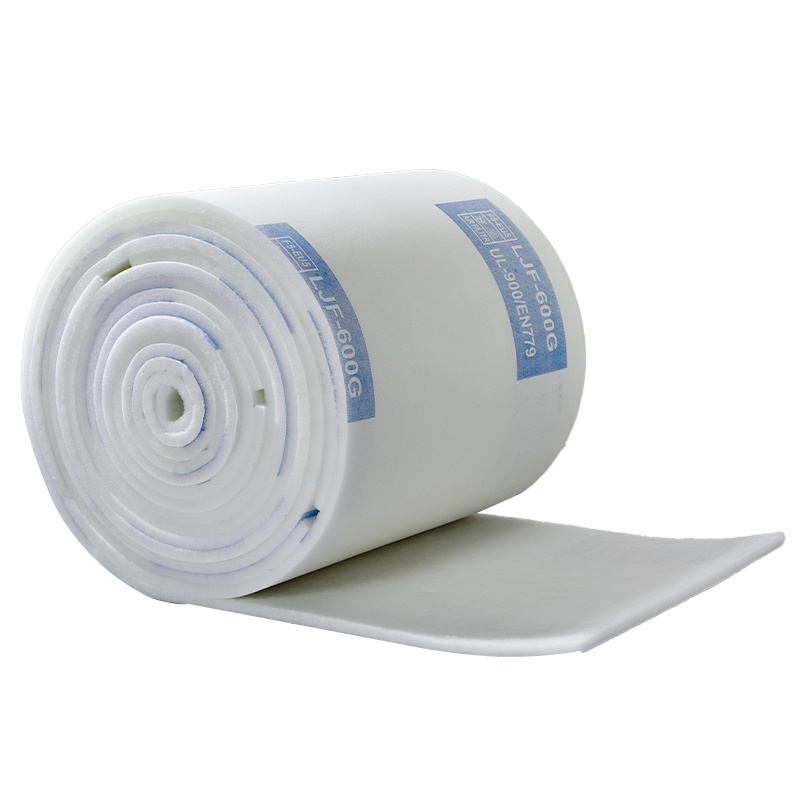
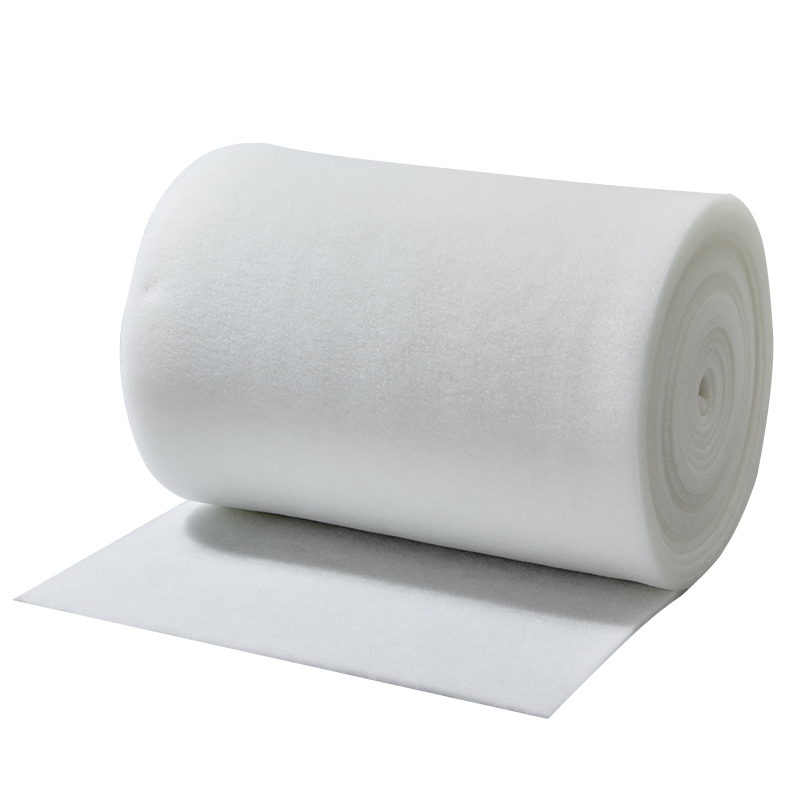
For example, LJF-600G uses synthetic fiber media with thermal bonding, full-depth adhesive treatment, and a gradient-density structure. These construction features are intended to improve particle retention while maintaining airflow permeability.
B. Adhesive Treatment and Dust Retention
Some ceiling filter media receives adhesive or tackifier treatment to improve the retention of captured particles.
This treatment helps prevent accumulated dust from becoming easily released back into the airflow.
However, adhesive distribution matters. Excessive or uneven adhesive application may increase airflow resistance, while insufficient treatment may reduce particle retention.
A consistent manufacturing process is therefore important for maintaining stable filtration performance.
C. Airflow Resistance and Pressure Drop
Pressure drop refers to the difference in air pressure measured before and after air passes through a filter.
It is usually expressed in pascals (Pa).
A filter with excessive resistance may reduce the airflow delivered by the ventilation system, particularly when the fan has limited capacity.
A filter with insufficient particle retention may allow contaminants to reach the painting area.
The objective is not simply to maximize media weight, but to achieve the required filtration performance within the spray booth's available airflow and pressure budget.
D. Dust Holding Capacity
Dust holding capacity describes how much test dust a filter can retain under specified testing conditions before reaching a defined terminal resistance.
It can influence replacement intervals and maintenance costs.
Nevertheless, a higher dust holding capacity does not automatically guarantee a longer service life in every paint booth. Actual operating conditions, incoming dust concentration, spraying schedules, and maintenance practices all matter.
3. LJF-600G Spray Booth Ceiling Filter: Technical Specifications
For buyers evaluating 600G ceiling filter media, reviewing actual product specifications is more useful than relying on the product name alone.
Guangzhou LJF's LJF-600G spray booth ceiling filter media is designed for industrial painting systems, automotive refinishing facilities, and spray booth supply-air applications.
The published specifications are as follows:
| Technical Parameter | LJF-600G Specification |
|---|---|
| Model | LJF-600G |
| Filter Class | F5 / M5 (supplier-declared) |
| Average Capture Rate | 99% (published product figure) |
| Material | Synthetic fiber |
| Weight | 600 g/m² |
| Thickness | 22 ± 2 mm |
| Dust Holding Capacity | 450 g/m² |
| Rated Air Velocity | 0.25 m/s |
| Initial Pressure Drop | 45 Pa |
| Final Pressure Drop | 450 Pa |
| Adhesive Treatment | Full glue |
| Standard Roll Sizes | 1 × 21 m, 1.6 × 21 m, 2 × 21 m |
Source: LJF-600G published product specifications. Performance figures should be interpreted according to their applicable test methods and conditions.
These figures provide several useful points for technical evaluation.
First, the 600 g/m² basis weight identifies the amount of filter material per unit area. The 22 ± 2 mm thickness describes its physical depth.
Second, the published initial pressure drop of 45 Pa provides a reference for assessing airflow resistance at the specified test conditions. The final pressure drop of 450 Pa is the published terminal resistance figure, not a recommended universal replacement threshold for every installation.
Third, the stated dust holding capacity of 450 g/m² offers an additional reference for comparing media under equivalent testing conditions.
For procurement teams, it is important to request the relevant test reports and confirm the test airflow, sample dimensions, conditioning procedure, and efficiency calculation method before making direct comparisons between suppliers.
Product reference: LJF-600G Spray Booth Ceiling Filter Media
4. 600G vs. 500G vs. 460G vs. 400G: Which Should You Choose?
Different spray booth installations have different ventilation requirements. Selecting the highest available gram weight is not necessarily the most economical or technically appropriate decision.
The following comparison uses LJF's published product specifications:
| Parameter | 600G | 500G | 460G | 400G |
|---|---|---|---|---|
| Media Weight (g/m²) | 600 | 500 | 460 | 260* |
| Thickness (mm) | 22 ± 2 | 22 ± 2 | 22 ± 2 | 22 ± 2 |
| Average Capture Rate | 99% | 99% | 97% | 90% |
| Dust Holding (g/m²) | 450 | 400 | 370 | 350 |
| Initial Pressure Drop (Pa) | 45 | 40 | 35 | 30 |
| Final Pressure Drop (Pa) | 450 | 400 | 400 | 400 |
| Adhesive Treatment | Full glue | Full glue | Surface glue | No glue |
Important: LJF's published product table lists the 400G model with a weight of 260 g/m², despite its model designation. Buyers should confirm this specification directly before ordering.
The comparison highlights an important purchasing consideration: different media constructions offer different combinations of particle capture, pressure drop, and dust holding capacity.
For facilities seeking higher dust retention and a full-depth adhesive-treated construction, 600G may be worth evaluating. For other systems, a lighter option may provide sufficient performance with lower initial resistance.
The final decision should be based on the ventilation system design, required air cleanliness, filter test data, and operating costs.
5. How Does a Spray Booth Ceiling Filter Work?
A typical downdraft spray booth uses a controlled airflow arrangement to reduce contamination around the painted workpiece.
The basic filtration process can be represented as follows:
Fresh Air Intake
↓
Pre-Filtration
↓
600G Ceiling Filter Media
↓
Clean Air Distribution into the Spray Booth
↓
Painting Area
↓
Overspray Collection by Floor Filter
↓
Exhaust Filtration System
The ceiling filter and floor filter have different functions.
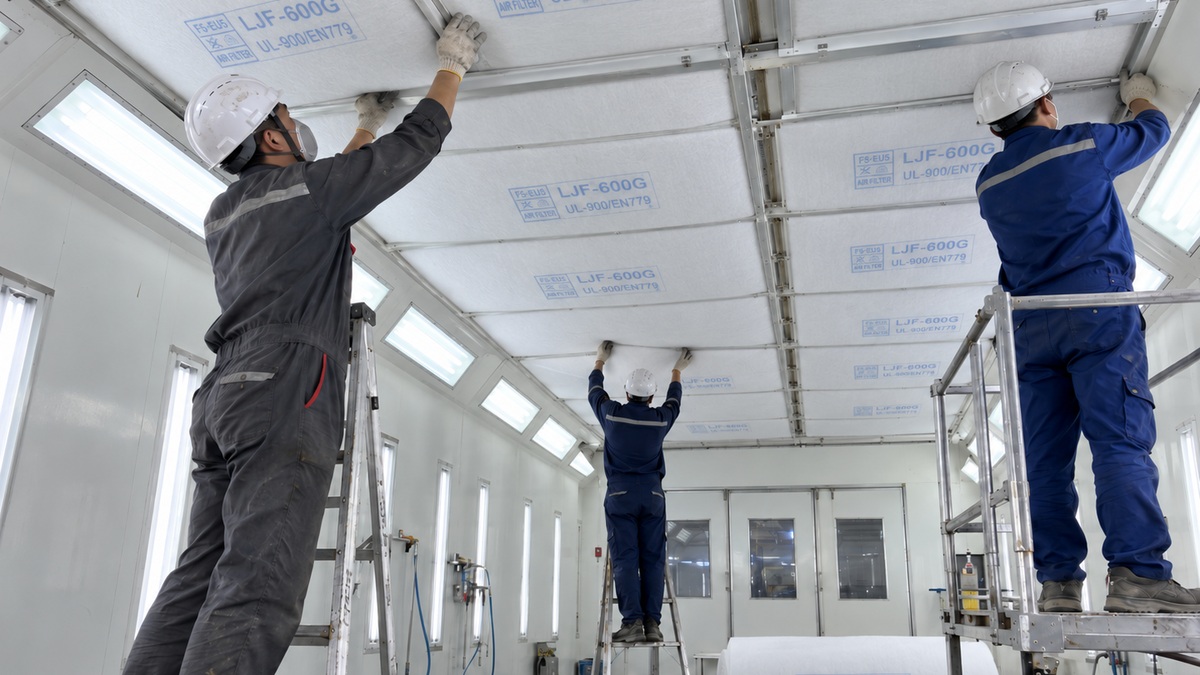
The ceiling filter is installed on the supply-air side. Its primary role is to reduce incoming dust and help distribute clean air evenly across the working area.
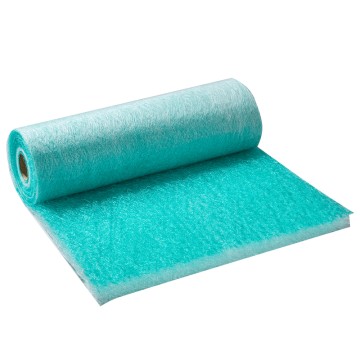
The floor filter, commonly made from fiberglass paint-stop media, captures paint overspray carried toward the exhaust system.
Confusing these two filter positions can result in inappropriate product selection. A ceiling filter should not automatically be substituted for an exhaust paint-arrestor filter.
The Occupational Safety and Health Administration (OSHA) provides additional requirements for spray finishing operations in 29 CFR 1910.107. These include ventilation, filter inspection, and fire-safety provisions for applicable spray booth installations.
6. Five Factors to Check Before Purchasing 600G Ceiling Filter Media
A product specification sheet should provide more information than just the gram weight.
Professional buyers should consider the following factors:
1. Airflow Compatibility
Check the rated face velocity and pressure drop against the spray booth manufacturer's requirements. A filter that creates excessive resistance can affect the ventilation system's operating balance.
2. Filtration Efficiency
Ask how the stated efficiency was measured. Confirm the particle size range, test dust or aerosol, test velocity, and calculation method. Do not assume that two products with the same advertised efficiency are equivalent.
3. Fiber Construction and Adhesive Treatment
Check whether the media uses progressive-density fibers, thermal bonding, and suitable adhesive treatment. These characteristics influence particle retention and resistance to fiber shedding.
4. Flame-Retardant Performance
Spray booths can involve combustible coating materials and residues. Request product-specific flame-retardancy documentation and verify compatibility with applicable local fire and safety requirements.
5. Dimensions and Installation Compatibility
Confirm the roll width, length, thickness, cutting requirements, and installation direction. An incorrectly fitted ceiling filter may allow air to bypass the media, reducing the effectiveness of the filtration system.
A useful procurement practice is to test a representative sample in the actual installation before approving a large-volume order.
7. Why Manufacturing Quality Matters for 600G Filter Media
A 600G label does not guarantee consistent performance from one production batch to another.
Manufacturers must control several production variables, including fiber distribution, bonding consistency, media thickness, adhesive application, and finished-roll uniformity.
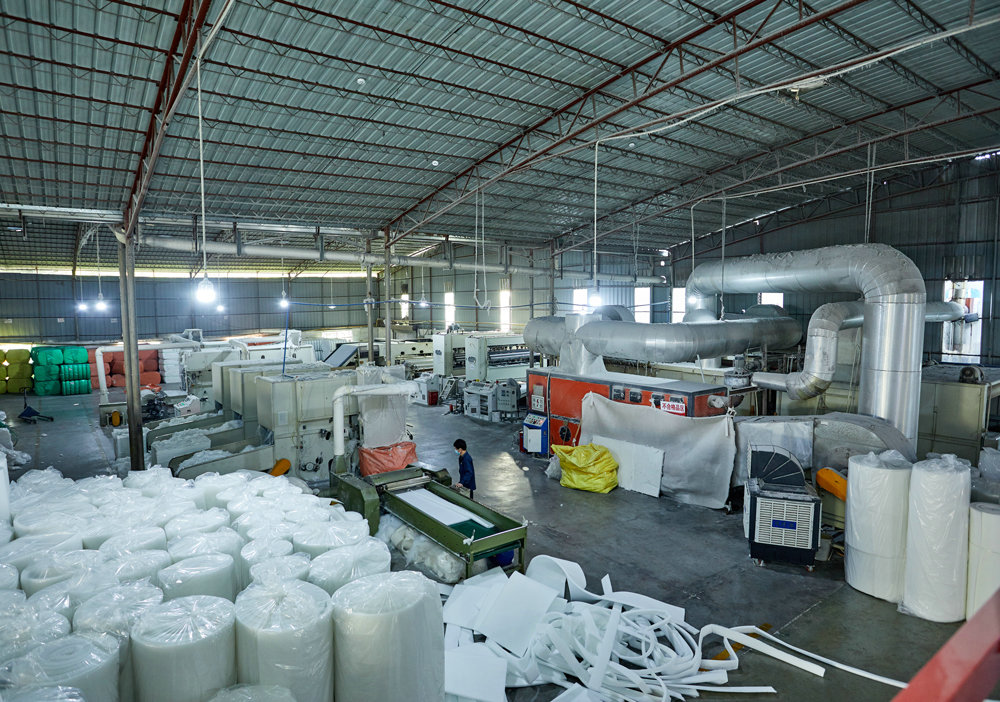
At Guangzhou LJF, our industrial air filtration manufacturing operations cover filter media production, filter processing, frame assembly, and finished-product manufacturing. We provide OEM and ODM support for customers requiring different dimensions, specifications, and product configurations.
Our LJF-600G ceiling filter is developed for spray booth supply-air applications where dust control, stable airflow, and media construction are important considerations.
We recommend that distributors, spray booth manufacturers, and industrial end users evaluate the complete technical specification rather than choosing a product solely by its nominal gram weight.
For customized requirements, buyers can provide their existing filter dimensions, target airflow velocity, pressure-drop limits, and application details so that the appropriate media configuration can be evaluated.
8. Frequently Asked Questions About 600G Spray Booth Ceiling Filters
Q1. Does 600G mean 600 grams per square meter?
Yes. In this product context, 600G normally refers to a nominal basis weight of 600 g/m², also called 600 GSM. Always confirm the supplier's unit and measurement method.
Q2. Does a 600G filter have better filtration efficiency than a 400G filter?
Not automatically. Higher basis weight means more material per unit area, but filtration efficiency also depends on fiber diameter, density distribution, bonding, and other construction characteristics. Actual test results are needed.
Q3. What is the difference between a 600G ceiling filter and a paint-stop filter?
A 600G ceiling filter is installed in the supply-air system to help prevent incoming dust from contaminating the painting area. A paint-stop filter is generally installed on the exhaust side to capture paint overspray.
Q4. How often should 600G spray booth ceiling filter media be replaced?
There is no universal replacement interval. Monitor differential pressure, booth airflow, visible contamination, paint quality, and the equipment manufacturer's maintenance recommendations. Replace the media when its operating condition reaches the defined maintenance limit.
Q5. Can 600G spray booth ceiling filter media be customized?
Yes. Depending on the manufacturer's production capabilities, customers can request different roll widths, lengths, thicknesses, gram weights, and other construction requirements. LJF provides OEM/ODM customization for industrial filtration products.
Q6. Is 600G suitable for every spray booth?
No. Suitability depends on the booth's ventilation design, required filtration performance, airflow velocity, pressure-drop allowance, and operating conditions. Always check compatibility with the original equipment specifications.
Conclusion-Free Technical Takeaway
600G in spray booth ceiling filter media generally describes a nominal basis weight of 600 grams per square meter. It is an important material specification, but it should never be treated as a standalone indicator of filtration efficiency or product quality.
For a reliable purchasing decision, evaluate basis weight alongside thickness, fiber structure, adhesive treatment, pressure drop, dust holding capacity, and independently documented performance.
By understanding these parameters, spray booth operators and industrial buyers can make better-informed decisions, improve filtration-system compatibility, and maintain more consistent painting conditions.