

HEPA H13 vs. H14 Which Efficiency Level Does Your Cleanroom Actually Need
HEPA H13 vs. H14: Which Efficiency Level Does Your Cleanroom Actually Need?
Choosing between H13 and H14 Hepa Filters looks simple on a specification sheet: H13 is rated at≥99.95% efficiency at MPPS, while H14 reaches ≥99.995%. But cleanroom filtration is rarely that simple. The filter grade is only one part of the contamination-control system.
The actual requirement depends on the cleanroom classification, process sensitivity, airflow design, terminal filtration, filter sealing, pressure drop, maintenance strategy, and how the installed filter is tested. In some applications, moving from H13 to H14 provides a meaningful additional margin. In others, improving airflow distribution, eliminating bypass leakage, or upgrading pre-filtration may have a greater practical impact.
This guide explains the engineering difference between H13 and H14 and provides a practical way to determine which grade makes sense for your cleanroom.
H13 vs. H14: The Efficiency Difference Is Small on Paper but Large in Penetration
Under the EN 1822 classification system, HEPA filters are evaluated at the Most Penetrating Particle Size (MPPS)rather than simply at a fixed particle size such as 0.3 microns. MPPS represents the particle size range that is most difficult for the Filter Media to capture.
| Filter Class | Minimum Overall Efficiency at MPPS | Maximum Overall Penetration | Typical Engineering Role |
|---|---|---|---|
| H13 | ≥99.95% | ≤0.05% | High-efficiency cleanroom terminal filtration |
| H14 | ≥99.995% | ≤0.005% | Higher-containment and more demanding cleanroom applications |
| U15 | ≥99.9995% | ≤0.0005% | Ultra-clean applications |
The difference between H13 and H14 is therefore not simply “0.045 percentage points.” H14 allows approximately one-tenth of the particle penetration permitted by H13 at MPPS. That additional filtration margin can matter when the allowable airborne particle concentration is extremely low.
The U.S. Environmental Protection Agency also explains why the commonly quoted 0.3-micron figure should not be confused with the actual HEPA classification method. A conventional HEPA definition refers to at least 99.97% removal at 0.3 microns, while the 0.3-micron particle size is associated with a worst-case penetration region. EN 1822, meanwhile, uses MPPS-based classification for high-efficiency filters.
Do You Need H13 or H14? Start With the Cleanroom, Not the Filter
A common purchasing mistake is to begin with the question, “Should we buy H13 or H14?” A better engineering question is, “What particle concentration must the room achieve under its operating conditions?”
ISO 14644-1 classifies cleanroom air cleanliness according to airborne particle concentration at specified particle sizes. It does not simply assign a HEPA grade to every ISO cleanroom. This distinction is important because the cleanroom classification and the HEPA filter classification describe different things.
| Design Consideration | What It Determines | Why It Matters for H13/H14 Selection |
|---|---|---|
| ISO cleanroom class | Maximum airborne particle concentration | Defines the cleanliness target |
| Process sensitivity | Consequences of contamination | Higher-risk processes may justify additional filtration margin |
| Airflow pattern | How clean air reaches the work zone | Poor distribution can undermine high-efficiency filtration |
| Terminal filter housing | Potential bypass paths | A high-grade filter cannot compensate for an unsealed installation |
| Fan capacity | Available airflow against system resistance | Higher pressure drop can affect actual air volume |
| Validation requirements | Proof of installed performance | Determines the required integrity and particle testing procedure |
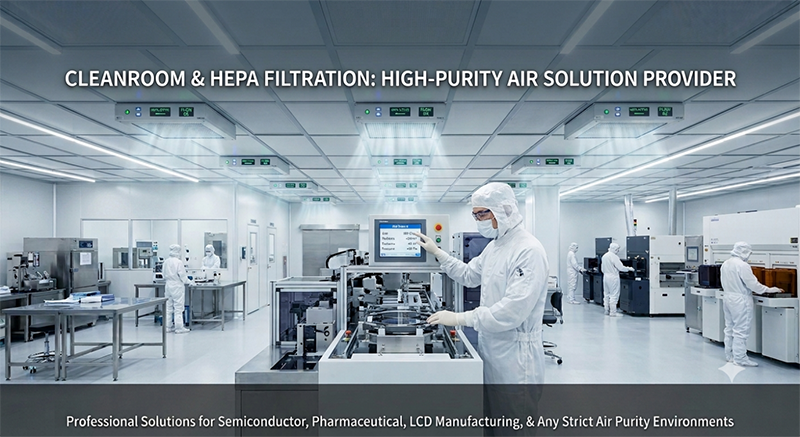
For example, LJF's cleanroom filtration experience covers applications including electronics manufacturing, semiconductor-related environments, pharmaceutical facilities, LCD production and laboratories. These environments do not necessarily have identical filtration requirements even when they use HEPA filters.
The key lesson is that cleanroom class is a system-level requirement, while H13 or H14 is a component-level filtration classification.
ISO states that ISO 14644-1 uses airborne particle concentration as the basis for cleanroom classification, with particle sizes from 0.1 to 5 microns included within the standard's classification framework.
When H13 Is Often the Practical Choice
H13 provides ≥99.95% overall efficiency at MPPS under EN 1822 classification. For many cleanroom applications, that level provides a strong balance between particle removal and system resistance.
H13 may be appropriate when the cleanroom design, process risk and validation protocol can achieve the required particle concentration without needing the additional penetration margin of H14.
H13 can make sense when:
- The cleanroom specification explicitly permits H13 terminal filtration.
- The target ISO classification can be maintained with the proposed airflow design.
- The process does not require exceptionally low particle penetration.
- The HVAC system has limited fan pressure capacity.
- Energy consumption is an important design consideration.
- Proper pre-filtration protects the HEPA stage from excessive dust loading.
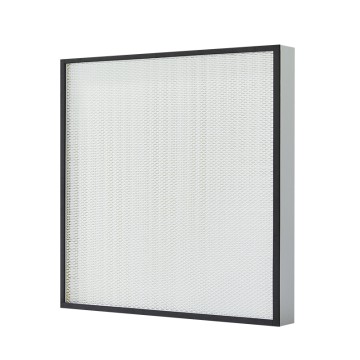
LJF's H13 mini-pleated HEPA filters, for example, use ultra-fine glass-fiber media and separator-free mini-pleat construction. Standard configurations are available in several dimensions and airflow capacities, with special sizes available for customized applications.
LJF specifies H13 performance at ≥99.95% at MPPS according to EN 1822 and provides individual integrity testing for HEPA units before shipment. This type of testing is important because the performance of the filter media alone does not guarantee the performance of the finished filter assembly.
When H14 Deserves Serious Consideration
H14 raises the minimum overall efficiency to ≥99.995% at MPPS. That means the allowable penetration is reduced from 0.05% for H13 to 0.005% for H14.
This additional margin becomes more relevant when contamination control is directly connected to product quality, sterility, yield, or process reliability.
H14 may be considered when:
- The project specification directly calls for H14.
- The process has particularly stringent airborne-particle requirements.
- The terminal filtration stage is designed for higher containment.
- The facility operates in a high-sensitivity pharmaceutical, biotechnology, electronics or semiconductor environment.
- Validation requirements require the additional filtration margin.
- The HVAC and FFU system can maintain the required airflow at the filter's operating pressure drop.
Healthcare guidance from NHS England similarly notes that H13 and H14 HEPA filters have minimum efficiencies of 99.95% and 99.995%, respectively, at MPPS, while also emphasizing that installed performance can be affected by filter design, device design and airflow rate.
The Hidden Variable: Pressure Drop and Airflow
One of the most overlooked differences between filter grades is not the efficiency percentage itself, but the relationship between efficiency, filter media area, airflow and pressure drop.
A filter with greater resistance can require more fan pressure to maintain the same airflow. If the system cannot provide that pressure, actual airflow may fall. A lower airflow rate can then affect air changes, room pressure, airflow patterns and contamination control.
LJF's published H13 mini-pleated specifications include configurations with rated airflow from approximately 700 to 2,600 m³/h and initial pressure-drop limits around 220 Pa, depending on filter dimensions and configuration. These figures are examples rather than universal design values; actual selection should be based on the required airflow, face velocity, filter dimensions and fan characteristics.
This is why a procurement specification should not say only “H14 HEPA filter.” It should also identify the required dimensions, rated airflow, allowable pressure drop, frame construction, sealing method and test standard.
Why H14 Cannot Fix a Leaking Cleanroom System
A filter can meet H14 efficiency in a laboratory test and still fail to deliver the expected room performance if contaminated air bypasses the filter.
Common bypass paths include damaged filter media, incomplete sealant, poor gasket compression, gaps between the filter and housing, damaged frames and installation errors.
This is particularly important for terminal HEPA filtration. The cleanroom receives air through the complete assembly, not through the filter media in isolation.
| Potential Weak Point | Possible Result | Recommended Control |
|---|---|---|
| Filter media damage | Localized particle penetration | Individual scan or integrity testing |
| Sealant discontinuity | Air bypass | Continuous seal inspection |
| Gasket problem | Leakage around the frame | Correct compression and installation |
| Excessive airflow | Higher resistance and altered performance | Design around rated airflow |
| Dirty pre-filters | Higher system resistance | Scheduled pre-filter replacement |
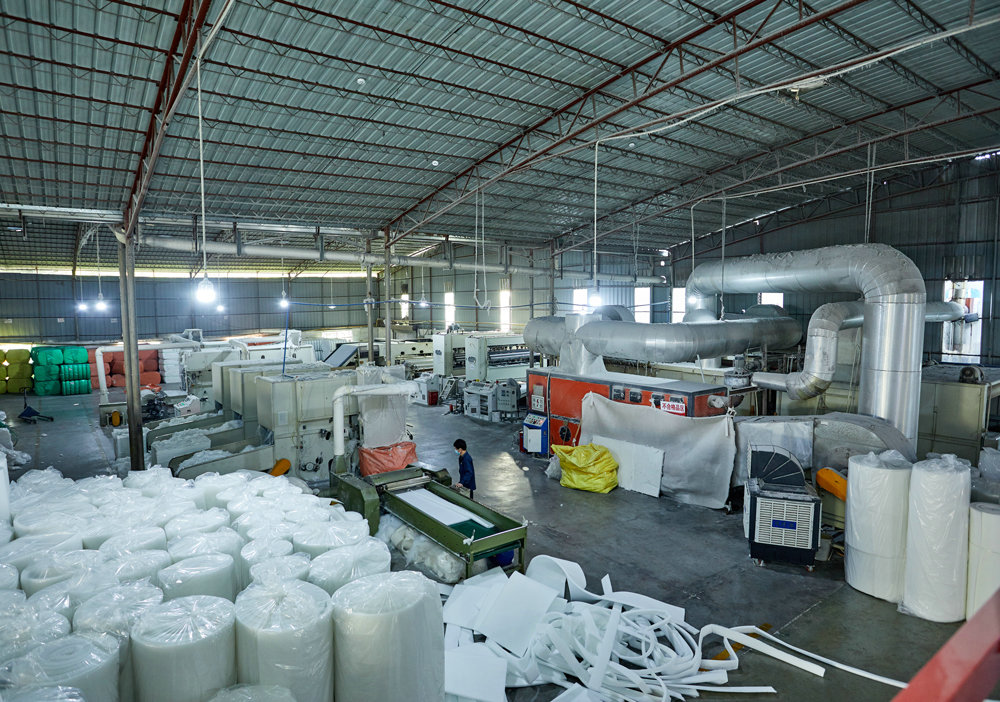
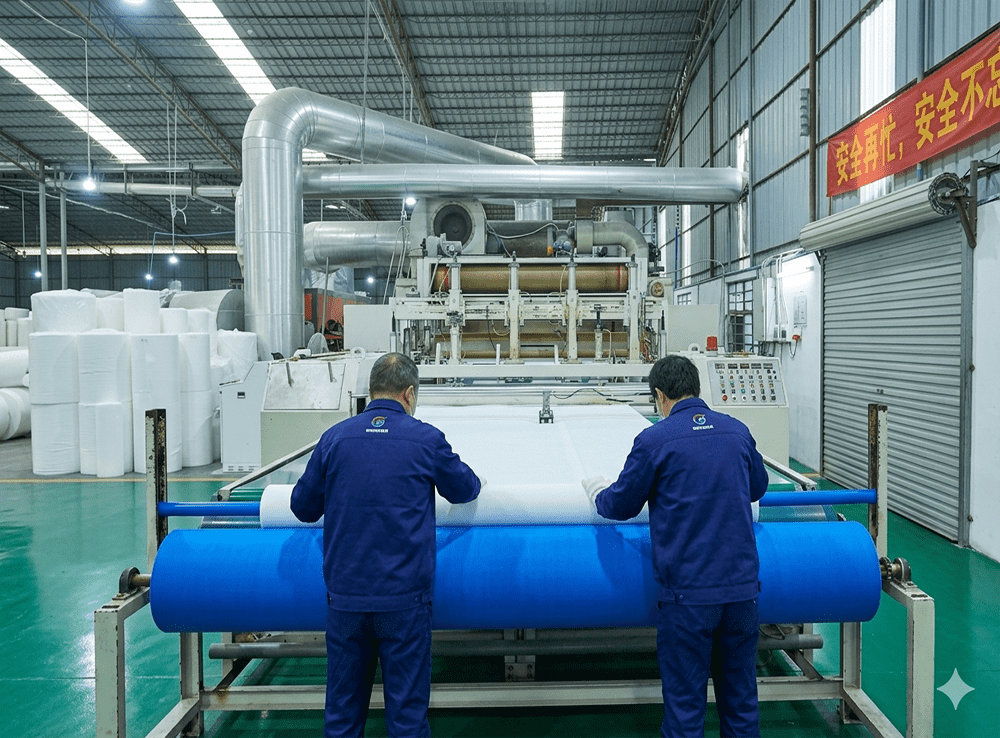
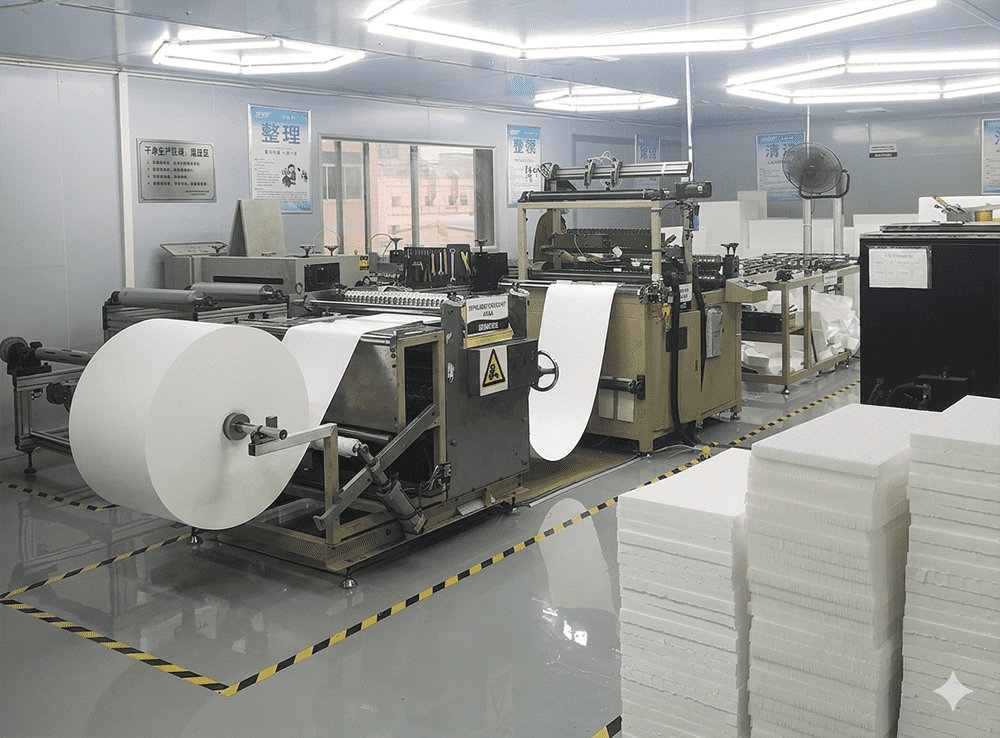
At LJF, HEPA assembly includes individual smoke-leak or integrity testing for H13/H14 units before shipment. The company's manufacturing process integrates filter media production, pleating, frame assembly and finished filter testing, allowing quality checks to be performed across multiple stages rather than only at final packaging.
Learn more about LJF's manufacturing and HEPA testing process
Do Not Ignore the Pre-Filters
A high-efficiency HEPA filter should normally be protected by an appropriate upstream filtration strategy. Sending large quantities of dust directly toward the H13 or H14 stage can accelerate loading and increase pressure drop.
A typical cleanroom air-handling arrangement may therefore include several stages:
- Coarse pre-filtration: captures larger particles and protects downstream equipment.
- Fine filtration: removes a larger proportion of smaller particles before the HEPA stage.
- HEPA terminal filtration: provides the final high-efficiency particle removal stage.
- Air distribution: delivers filtered air to the controlled zone at the required airflow.
LJF supplies a range of pre-filters, pocket filters and fine filtration products that can be configured with HEPA systems. The purpose is not simply to add more filters, but to create a staged filtration system that protects the expensive final filter while maintaining an acceptable total pressure drop.
This approach is especially relevant for facilities where filter replacement intervals, fan energy and maintenance labor have a significant effect on operating costs.
A Practical H13 vs. H14 Selection Checklist
Before specifying H13 or H14 for a new cleanroom project, an engineer or purchasing team can work through the following sequence:
- Define the required ISO cleanroom class. Determine the maximum allowable airborne particle concentration.
- Identify the process risk. Consider whether particle contamination affects product quality, yield, sterility or process reliability.
- Calculate the required airflow. Do not select a filter grade without checking airflow volume, velocity and distribution.
- Compare H13 and H14 pressure-drop data. Verify that the fan or FFU has sufficient pressure capacity.
- Specify the filter dimensions and frame. The housing must be compatible with the filter and sealing method.
- Define the testing requirement. Request EN 1822 or ISO 29463 documentation and appropriate individual integrity test records.
- Plan the pre-filtration stages. Protect the HEPA filter from excessive dust loading.
- Validate the installed system. Test the complete installation rather than relying only on the factory filter certificate.
H13 vs. H14: A More Useful Engineering Decision
The question is not whether H14 is “better” than H13. H14 simply provides a higher minimum filtration efficiency at MPPS. The appropriate specification depends on what the cleanroom is designed to achieve.
For many controlled environments, H13 can provide the required performance while maintaining a practical balance between filtration efficiency, airflow and system resistance. For more demanding contamination-control applications, H14 can provide an additional reduction in particle penetration when the rest of the HVAC system is designed to support it.
The most reliable approach is therefore to select the HEPA grade as part of the complete system design: ISO classification → process risk → airflow → filter efficiency → pressure drop → sealing → testing → validation.
Guangzhou LJF supports both H13 and H14 HEPA filtration solutions, including mini-pleated configurations, customized dimensions and individual filter integrity testing. With more than 10 years of air-filtration experience, customers in more than 30 countries and an integrated manufacturing process covering filter media, pleating, assembly and testing, LJF can work from a filter drawing, existing sample or cleanroom application requirement when developing a filtration specification.