
Leave Your Message
Paint Booth Filters do different jobs. Some keep dust out of the painting area; others capture overspray before it reaches the exhaust ductwork. Using the wrong medium—or placing it in the wrong position—can affect finish quality, airflow and maintenance costs.
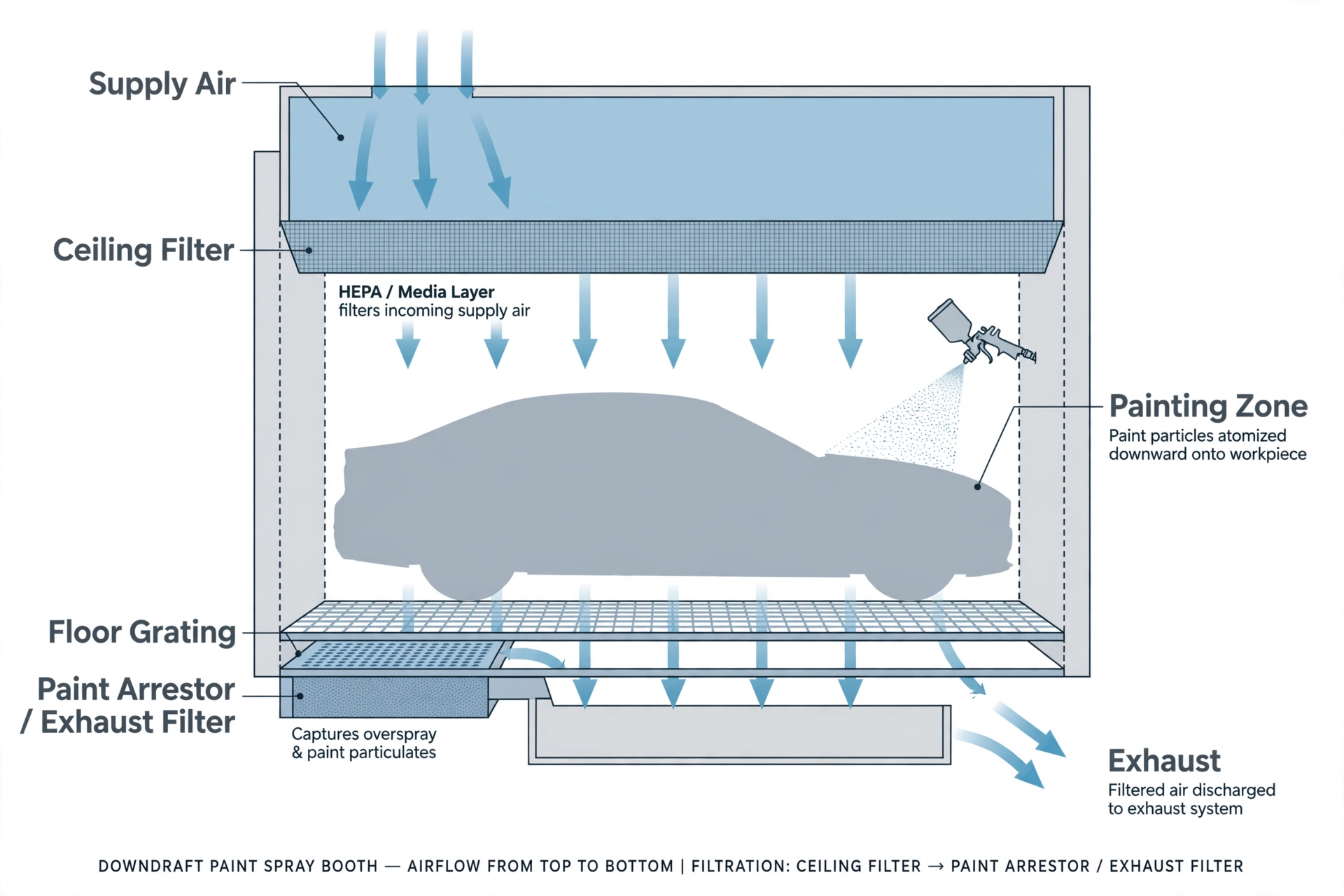
For a typical dry-filter downdraft spray booth, the main stages are intake pre-filtration, ceiling filtration and floor-mounted paint arrestors. Crossdraft booths commonly use wall-mounted intake and exhaust filters instead. Always start with the booth's airflow design, not just the filter dimensions.
Intake filters remove larger airborne contaminants from incoming air before it reaches the painting zone. They may be synthetic media rolls or framed panels, depending on the air-supply system. Effective pre-filtration helps reduce the dust load on downstream filters, particularly in busy workshops or dusty locations.
Do not choose an intake filter solely by its efficiency label. Filter area and initial pressure drop also matter: a filter that creates too much resistance can reduce the airflow the booth was designed to deliver.
In downdraft and semi-downdraft booths, Ceiling Filters help remove fine airborne particles from supply air as it enters the painting area. Their construction should support steady airflow and dependable particle retention. Damaged media, gaps around the mounting frame or unsuitable replacements can allow dust to bypass the filter.
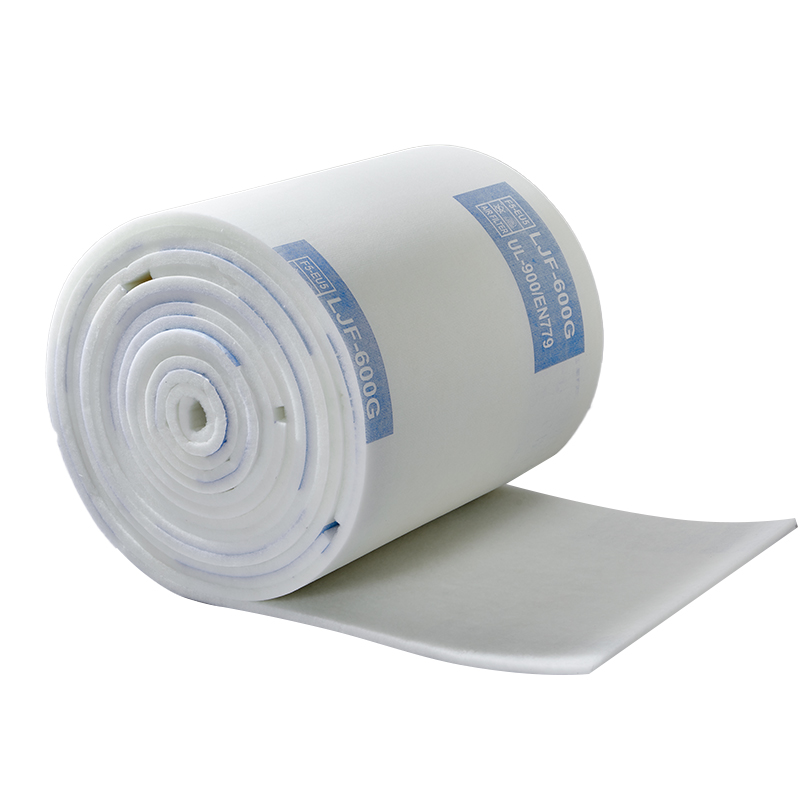
LJF's LJF-600G ceiling filter media is a synthetic-fiber product with a published nominal weight of 600 g/m² and thickness of 22 ± 2 mm. The product listing reports an initial pressure drop of 45 Pa at 0.25 m/s face velocity. Standard listed rolls include 1 × 21 m, 1.6 × 21 m and 2 × 21 m; custom dimensions can be discussed for OEM applications.
"600G" describes nominal media weight, not a filtration efficiency grade. Compare the original specification, operating airflow and verified test conditions before approving a replacement.
Paint arrestors capture airborne paint droplets and particles leaving the booth. In downdraft systems they are normally installed below the floor grating; in crossdraft systems, they are generally mounted on the exhaust wall. Their task is different from that of ceiling filters: they must hold paint overspray while allowing the required exhaust airflow.
Fiberglass paint stop media is widely used for dry overspray collection. Its open, depth-loading structure can collect paint within the media rather than only on the surface. Folded or V-type paper arrestors are another option in booths designed for that format. Which works best depends on coating type, spray volume, air velocity and the filter-holding arrangement.
LJF supplies fiberglass paint arrestor media and V-type paint filter paper alongside ceiling and intake media. For bulk supply or replacement parts, the installation dimensions and original product specification should be checked before choosing a roll or finished filter.
| Booth design | Supply-air filters | Overspray collection |
|---|---|---|
| Downdraft | Pre-filter + ceiling filter | Floor paint arrestor |
| Semi-downdraft | Pre-filter + ceiling filter | Rear-lower exhaust arrestor |
| Crossdraft | Wall-panel intake filter | Opposite-wall arrestor |
| Water-wash | According to booth design | Water-wash system; additional filters vary |
Before ordering, ask the booth operator for five things: (1) filter location; (2) exact width, length and thickness or frame size; (3) existing media type or a clear photo; (4) airflow or pressure-drop requirements, if available; and (5) paint type and expected spray usage. These details are usually more useful than an equipment model name on its own.
Check whether the supplier can provide product-specific technical data and relevant fire-performance documentation. Apparent similarities in colour or weight do not establish equal performance or compatibility.
There is no universal replacement schedule. Exhaust filters can load quickly in a production booth, while ceiling filters may have a different service interval. Monitor differential pressure, visible loading, airflow changes, damaged media and paint-finish contamination. Follow the booth manufacturer's maintenance limits and site safety procedures rather than waiting for the filter to appear completely blocked.
No—not by themselves. Ordinary ceiling media, fiberglass paint arrestors and paper overspray filters are designed mainly for particulate filtration. Solvent vapours and volatile organic compounds require separate engineering controls where applicable. Do not treat a paint arrestor as a complete VOC removal system.
No. Ceiling filters are typical of downdraft arrangements; crossdraft booths commonly use inlet filters on a wall or at one end of the booth.
Not as a direct substitution. Overspray collection and intake-air cleaning have different performance requirements.
Not necessarily. Media weight alone does not determine capture efficiency, airflow resistance or service life. Compare test data and the original booth requirements.
Guangzhou LJF Air Purification Equipment Co., Ltd. manufactures ceiling filter media, fiberglass paint arrestors, intake filter media and related products for automotive refinishing and industrial painting. For replacement supply or custom sizes, send your filter dimensions, application, expected quantity and—if available—the original technical specification. LJF can review the information and discuss suitable options.
Browse the full spray booth filter range.