Leave Your Message
0%

Picking the right filtration system isn't just a matter of saving a few bucks—it actually impacts the quality of your finish, how much energy you use, worker comfort, and how reliable your booth stays. When it comes to automotive manufacturers, the best Paint Booth Filtration system from a trusted China supplier should offer more than just a good price. Things like steady airflow, consistent pressure, reliable filter media, and clear guidance on when and how to replace them are pretty much essential.

Daniel Wei, who’s the Technical Director at Guangzhou CleanAir Technology Co., Ltd., puts it simply: “Filtration is a system. The filter alone can't fix a poor airflow design.” His words ring true. You see, automotive spray booth filters need to catch overspray without choking off the airflow too much. A filter that causes too much pressure drop can make your fans work overtime and mess with your spray patterns. On the flip side, a weak filter might let paint particles sneak past into the exhaust or even onto finished panels, which is obviously not what you want.

So, pay attention to those little details.

A good, reputable supplier in China should be able to tell you about the filter’s efficiency, media structure, what materials the frame is made of, sealing methods, and pressure-drop readings. They should also be able to provide batch traceability and clear test reports. When choosing intake filters, ISO 16890 data can be helpful. But remember, the final stage always needs to be tailored to your specific booth because factors like the type of paint, spray volume, airflow direction, and maintenance routines all come into play.

At Guangzhou CleanAir Technology Co., Ltd., they support OEM production lines, repair shops, and custom booth projects with layered filtration solutions. And yes, taking proper site measurements is crucial—and so is having good communication after the sale.

Keep in mind: no filter lasts forever.

Choosing the right filter involves more than just picking one and forgetting about it. Think about inspection intervals, safe handling practices, inventory planning, and disposal regulations. And it’s worth noting—the biggest mistake often overlooked is installing a high-quality filter incorrectly. That’s why it’s so important to rely on supplier expertise, keep detailed records of how you've used filters, and be honest about the technical performance during the process.
Best Automotive Paint Booth Filtration System China Supplier

What an Automotive Paint Booth Filtration System Does

Best Automotive Paint Booth Filtration System China Supplier

What an Automotive Paint Booth Filtration System Does

An automotive paint booth filtration system controls airborne overspray during vehicle refinishing. It draws contaminated air through layered filters before releasing or recirculating it. This process protects booth surfaces, paint quality, and nearby workers.

The Paint Booth Air Filtration System captures paint particles that would otherwise settle on wet panels. A clean intake filter supports steady airflow and reduces dust entering the booth. Exhaust filters collect overspray from the air stream. The result is a smoother finish, with fewer rough spots and visible defects.

Airflow matters greatly. Too little pressure can leave paint suspended around the vehicle. Excessive airflow may disturb the spray pattern and waste coating material. Technicians should check pressure readings, filter loading, and airflow direction during daily operations. Small details matter here.

Filters do not last forever. A clogged filter can increase fan strain and change booth performance. Replacing it too early wastes money, while replacing it too late creates avoidable risks. This balance requires records, inspection, and practical judgment. Even experienced operators sometimes overlook a partially blocked intake filter. That mistake can quietly affect color consistency, drying behavior, and cleanup time.

How Automotive Paint Booth Filters Capture Paint Contaminants

How Automotive Paint Booth Filters Capture Paint Contaminants

A Paint Booth Filtration System removes contaminants through airflow, fiber contact, and pressure control. During spraying, wet paint droplets travel toward the exhaust path. Larger droplets strike filter fibers and lose momentum. Smaller particles follow the air stream, then meet fibers through interception and diffusion. The pattern matters.

U.S. EPA AP-42, Chapter 4.2, identifies overspray and solvent evaporation as key emissions from coating operations. Filters mainly capture solid and liquid particles, not every vapor. A carbon stage may be required for selected solvent vapors. ASHRAE Standard 52.2 evaluates particle removal across approximately 0.3 to 10 micrometres. This range helps technicians compare filter performance more realistically.

In field inspections, a filter can look clean while its pressure drop rises. A clogged prefilter reduces airflow and may disturb the booth’s smooth air pattern. That disturbance can leave tiny particles on a freshly painted panel. It feels counterintuitive. Yet airflow often matters as much as filter media. OSHA 29 CFR 1910.107 also emphasizes suitable ventilation and regular maintenance for spray operations. Operators should record pressure readings, filter changes, paint type, and visible defects. That practical log creates stronger evidence than guessing from color alone. Filter efficiency claims still need caution, because humidity, coating viscosity, loading, and installation can change actual results.

How Automotive Paint Booth Filters Capture Paint Contaminants

Automotive paint booth filtration works in stages. Coarse filters remove larger overspray droplets, secondary filters capture finer paint mist, and final-stage filters reduce the smallest airborne particles before exhaust air leaves the booth. Actual performance depends on filter media, airflow, loading, installation, and the paint formulation.

Key Filter Types and Performance Specifications

Selecting the Best Automotive Paint Booth Filtration System China Supplier requires more than comparing filter prices. Filtration design must match airflow, paint load, booth size, and maintenance conditions. In real booth inspections, uneven filter loading often reveals poor air distribution. Each layer has a specific duty. Small details matter.

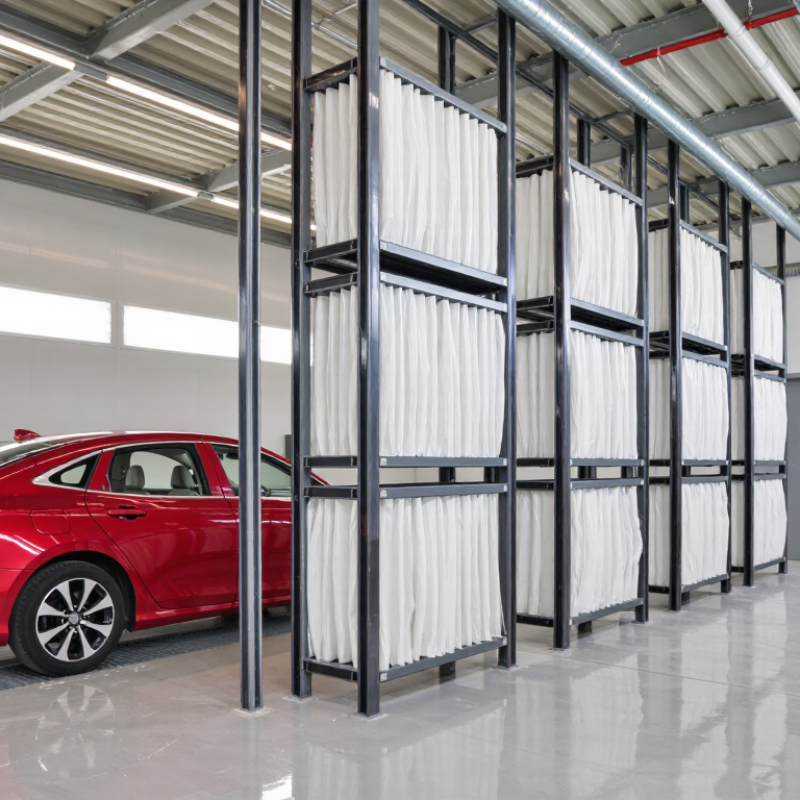
A Spray Booth Filtration System commonly uses intake prefilters, ceiling filters, paint arrestor media, and exhaust filters. Intake prefilters protect fans and remove larger dust particles. Ceiling filters provide cleaner, more uniform air across the spray zone. Their performance should include filtration class, airflow capacity, pressure drop, and dust-holding capacity. Paint arrestor filters capture overspray before it reaches the exhaust duct. Exhaust media needs strong capture efficiency without restricting airflow excessively. HEPA filtration may support high-cleanliness applications, but it requires careful pressure-drop evaluation. Oversizing sounds safe, yet it can increase energy use and complicate replacement.

A reliable supplier should provide test data, material specifications, and replacement guidance. Ask for initial and final resistance values, not efficiency claims alone. Filter dimensions must fit the frame without bypass gaps. During installation, check seals, airflow direction, and clamping pressure. I have seen good media perform poorly because technicians installed it backward. That mistake is easy to miss. Suppliers should also explain storage conditions and inspection intervals. My own preference is verified data over impressive wording, although field dust levels can still challenge laboratory results.

How to Evaluate a China-Based Filtration System Supplier

Choosing a China-based filtration supplier requires more than comparing catalog prices. In paint-booth projects, I examine airflow drawings, filter test reports, and replacement logistics together. ISO 16890 classifies air filters by particulate efficiency, but its results do not fully assess booth performance. Ask for pressure-drop curves at the intended airflow, not only a headline efficiency percentage. The U.S. EPA’s AP-42 guidance identifies spray coating as a significant VOC-emission activity, so capture performance deserves equal attention.

Request a factory audit, batch traceability, and a sample run using your actual coating process. A credible supplier should explain media construction, sealing methods, flame behavior, and disposal instructions clearly. Compare measured airflow before and after loading. The WHO 2021 Air Quality Guidelines set 5 μg/m³ as the annual PM2.5 guideline. This does not define booth acceptance, but it highlights the importance of surrounding air controls. I sometimes overvalue polished documents. That is a mistake.

Tips:
Ask for independent laboratory accreditation and the exact standard edition. Check whether testing covers the finished filter, not only raw media. Confirm lead times for filter pads, gaskets, and custom sizes. Calculate total cost from pressure drop, service hours, energy use, and waste handling. Visit an operating installation in China, if possible. Speak with its maintenance team. Their complaints may reveal more than a sales presentation. Keep a written acceptance test covering airflow, leakage, dust loading, and noise.

Safety Standards and Quality Checks for Paint Booth Filters

A reliable Paint Booth Filter System starts with documented safety requirements, not attractive airflow claims. When evaluating a China supplier, request filter-class information, pressure resistance data, flame behavior records, and material traceability. Filter media must fit the booth frame without gaps. Even a narrow edge leak can carry overspray into ductwork. That detail is often missed.

Before installation, inspect each filter for tears, dampness, crushed corners, and uneven pleats. Measure dimensions with a steel ruler, then record batch data and supplier certificates. During operation, compare the initial pressure drop with the approved technical range. A sudden increase may indicate loading, poor prefiltration, or restricted airflow. Use calibrated gauges. Replace filters according to readings and condition, not a convenient calendar date.

Safety also depends on worker practice. Operators need clear access, suitable protective equipment, and training for residue handling. Used filters should be sealed, labeled, and managed under applicable waste rules. Maintenance records should show dates, readings, defects, and corrective actions. Checklists improve consistency, but they do not replace judgment. A filter can pass paperwork and still fit badly. Recheck it in the booth.

Best Automotive Paint Booth Filtration System China Supplier - Safety Standards and Quality Checks for Paint Booth Filters
Filtration Stage Typical Filter Media Primary Function Typical Performance Data Key Quality Checks Safety and Compliance Considerations Replacement or Service Trigger
Intake Pre-Filter Synthetic or glass-fiber panel, pad, or pocket filter Captures coarse dust, lint, and airborne particles before they reach the booth supply plenum. Typical coarse-particle efficiency: approximately 60%–90%, depending on media class and test method. Check media thickness, frame dimensions, gasket condition, airflow direction, stitching, and absence of tears or bypass gaps. Use a correctly rated filter to protect downstream filters and maintain stable booth airflow. Replace when visibly loaded, damaged, wet, or when the measured pressure drop reaches the system limit.
Fine Supply-Air Filter Multi-pocket or rigid-panel synthetic filter Removes smaller particles from incoming air to reduce dust settling on wet paint. Typical final-filter classification may range from ISO Coarse to ISO ePM10 or ISO ePM2.5, depending on the design. Verify filter class, airflow capacity, pressure-drop curve, media uniformity, frame squareness, and seal integrity. Filter selection should be based on the booth fan capacity and the required air cleanliness, not efficiency alone. Service when pressure drop rises above the manufacturer’s operating limit or booth velocity becomes unstable.
Ceiling or Plenum Filter Paint-booth ceiling filter roll, blanket, or extended-surface media Provides uniform distribution of clean air across the spray zone and limits particle contamination. Common media basis weights are approximately 300–600 g/m²; actual performance depends on media construction and installation. Inspect media density, support grid, retaining clips, overlap, compression, edge sealing, and complete ceiling coverage. Improper installation can create air bypass, uneven airflow, turbulence, and finish defects. Replace if saturated with dust, deformed, loose, contaminated, or unable to maintain uniform airflow.
Exhaust Arrestor Filter Paint-arrestor fiberglass, polyester, or synthetic roll media Captures overspray particles before exhaust air enters the ductwork or external exhaust system. Typical overspray capture efficiency is application-dependent; performance must be verified against the filter’s technical data. Check airflow direction, holding frame, media loading pattern, flame-spread information, and resistance to solvent exposure. Overspray accumulation increases fire load and pressure drop; follow applicable spray-booth fire-safety requirements. Replace before the media becomes heavily loaded, brittle, wet with coating, or unable to maintain required exhaust airflow.
Exhaust Final Filter High-capacity pocket, panel, or cartridge filter Provides additional particulate control where the exhaust design requires higher filtration performance. Typical efficiency may range from ISO ePM10 to ISO ePM1, depending on the selected filter and test standard. Confirm certified efficiency, air-volume rating, pressure drop, seal design, filter-bag attachment, and structural strength. Do not use a higher-resistance filter unless the fan and motor can maintain the required airflow. Replace according to differential-pressure readings, airflow reduction, visible damage, or contamination limits.
Activated-Carbon Module Granular or impregnated activated carbon Controls selected solvent vapors and odors in systems specifically designed for gas-phase filtration. Gas adsorption capacity depends on carbon type, bed depth, humidity, solvent concentration, contact time, and temperature. Verify carbon mass, bed depth, housing seal, airflow distribution, odor breakthrough monitoring, and documented media specification. Carbon filtration does not replace ventilation, explosion protection, or control of flammable vapor sources. Replace after breakthrough detection, scheduled service interval, excessive moisture exposure, or exhausted adsorption capacity.
Filter Frame and Gasket Galvanized steel, aluminum, or coated steel frame with elastomeric gasket Maintains correct positioning and prevents unfiltered air from bypassing the filter media. Frame dimensions should match the specified nominal size; practical fit tolerance depends on the booth housing design. Measure length, width, depth, diagonal squareness, gasket continuity, corrosion condition, and clamping pressure. Air bypass can reduce effective filtration even when the filter media itself meets its efficiency rating. Repair or replace when the frame is bent, corroded, cracked, or unable to provide a continuous seal.
Differential-Pressure Monitoring Magnetic gauge, inclined manometer, or electronic pressure sensor Tracks filter loading and supports condition-based replacement. Measurement range must cover the clean-filter and loaded-filter pressure-drop values specified for the system. Check zero point, tubing connections, sensor calibration, alarm setpoint, and agreement with a reference instrument. Pressure monitoring helps prevent restricted airflow, excessive fan energy use, and loss of booth performance. Calibrate or replace the instrument if readings drift, fluctuate abnormally, or fail to respond to filter loading.
Filter Integrity Inspection Installed filter assembly and surrounding housing Confirms that the complete filtration system performs without gaps, tears, loose edges, or damaged seals. Inspection frequency should be risk-based; visual checks are commonly performed during routine booth maintenance. Inspect for holes, edge gaps, displaced media, wet coating, dust trails, corrosion, and signs of airflow bypass. Inspection should be completed with the fan isolated when access creates a mechanical or electrical hazard. Correct defects immediately when bypass, structural damage, or contamination could affect coating quality or safe operation.
Documentation and Traceability Inspection record, filter specification, batch information, and maintenance log Provides evidence that the supplied and installed filters match the approved technical requirements. Records should include filter dimensions, rated class, initial pressure drop, airflow rating, installation date, and replacement date. Review certificates, inspection results, calibration records, nonconformance actions, and storage conditions. Applicable references may include ISO 16890 for air-filter performance, ISO 29463 for high-efficiency filters where relevant, and NFPA 33 or local fire regulations for spray applications. Update records after every filter change, inspection, abnormal pressure reading, or process modification.
Performance note: Filter efficiency values are technology- and test-method-dependent. Final selection should be based on booth airflow, coating process, overspray loading, required finish quality, pressure-drop limits, local regulations, and the applicable product standard.

Installation, Maintenance, and Filter Replacement Planning

A dependable automotive paint booth filtration system begins with accurate installation. Before delivery, confirm booth dimensions, airflow direction, filter grades, and access space. A qualified technician should inspect the housing for damage and check every gasket. Loose seals can let dust bypass the filter. That small gap matters.

During installation, measure pressure across clean filters and record the reading. Use calibrated instruments, not visual judgment alone. The booth should maintain stable airflow around the vehicle, especially near doors and corners. Grounding, lighting, and ventilation connections also need careful inspection. Our early planning once focused too much on filter size. We later found that service access was equally important.

Maintenance should follow booth usage, coating volume, and workshop dust levels. Inspect pre-filters weekly in busy facilities. Check final filters and pressure readings during each scheduled service. Replace filters when pressure reaches the supplier’s recommended limit, or when airflow becomes unstable. Never shake contaminated filters indoors. Seal used filters in suitable containers and handle them under applicable local requirements. Keep a simple log with dates, pressure values, operating hours, and observations.

Plan replacement stock before peak production periods. A China supplier should provide filter dimensions, media specifications, pressure data, and installation guidance. Store unused filters flat, dry, and away from solvents. Keep one emergency set available. Not every replacement interval will match the calendar. Review the records monthly and adjust the schedule when dust loads change. Perfect planning is uncommon; documented correction is more reliable.

FAQS

What does an automotive paint booth filtration system do?

It removes airborne paint particles from booth air. Intake filters reduce dust, while exhaust filters capture overspray. This helps protect wet panels, workers, and booth surfaces.

How does filtration improve paint quality?

Clean airflow keeps dust away from wet vehicle panels. Fewer particles mean fewer rough spots and visible defects. The finish becomes smoother.

Why is airflow control important inside the booth?

Low airflow can leave paint suspended around the vehicle. Excessive airflow may disturb the spray pattern and waste coating material. Check pressure and airflow direction daily.

How can operators know when filters need replacement?

Record pressure readings, operating hours, and visible filter conditions. Replace filters at the recommended pressure limit. Unstable airflow also signals possible blockage.

How often should paint booth filters be inspected?

Inspect pre-filters weekly in busy workshops. Check final filters during scheduled service. Dust levels and coating volume may change the schedule.

What should be checked during system installation?

Confirm booth dimensions, airflow direction, filter grades, and service access. Inspect housings and gaskets carefully. A small seal gap can let dust bypass the filter.

How should used filters be handled?

Do not shake contaminated filters indoors. Seal them in suitable containers. Follow applicable local handling requirements and keep the work area clean.

How should replacement filters be stored?

Store unused filters flat and dry. Keep them away from solvents. An emergency set can prevent production delays. Perfect planning is uncommon.

What records help manage filter replacement?

Keep dates, pressure values, operating hours, and observations. Review the log monthly. Adjust the schedule when workshop dust levels change. Mistakes still happen.

Conclusion

An automotive paint booth filtration system is designed to control airborne paint overspray, dust, and other contaminants during vehicle refinishing. By guiding air through progressively finer filter layers, it helps protect painted surfaces, improve finish quality, support stable airflow, and reduce the spread of particles within the working environment. Common filter options include intake filters, ceiling filters, exhaust filters, and high-efficiency final-stage filters, with performance evaluated through filtration efficiency, airflow capacity, pressure drop, dust-holding capacity, and service life.

When selecting a Best Paint Booth Filtration System For Automotive China Supplier, buyers should assess manufacturing consistency, material quality, testing procedures, documentation, customization capability, and communication reliability. Filters should meet applicable safety and quality requirements, with checks for structural strength, sealing performance, airflow resistance, and contaminant capture. Proper installation, scheduled inspections, pressure monitoring, and timely replacement are essential for maintaining booth efficiency. A clear maintenance plan and dependable supply of replacement filters can also help control operating costs and support consistent painting performance.
Sophia

Sophia

Sophia is a dedicated marketing professional at Guangzhou LJF Purification Equipment Co., Ltd., where she harnesses her expertise to promote the company’s innovative air purification solutions. With a deep understanding of the industry and its challenges, Sophia plays a critical role in positioning......
Previous 5 Best Air Filter Media Roll Suppliers In China?